I have been back in Kenya a little over a week now, and it has busy time of seeing old friends, meeting new friends, and getting reoriented to life here in Nairobi.
I knew that I was definitely back in Kenya on Sunday when Rev Agola picked me up for worship at 8:00 am, and I did not return home until 6:30 that same evening. Before we even left the compound where I am staying, there was a problem with Rev Agola’s car: the battery was dead. Since no one had any jumper cables, he simply took the battery out of our friend Phyllis’ car and connected the two batteries with two metal tools. I closed my eyes so I didn’t have to see anyone electrocuted. To my great surprise it worked almost immediately, the car started, and we were on our way. We attended Loresho Community Church where Rev Agola is pastor. We sang, prayed, and worshipped together. Afterwards, there was lots of chai to drink and many new people to meet. I spent most of the afternoon with the pastor and his family in their home where we ate githeri, greeted church members, and, yes, took more chai. I am looking forward to everything this year will hold!

Thursday, September 17, 2009
Saturday, September 12, 2009
Safari Njema (Safe Journey)
Thanks be to God!
I made it safely to Nairobi Wednesday night after 20+ hours travelling. It is good to be back here, and every moment has confirmed that this is exactly where God has called me to be at this time. Yesterday, I was able to go and visit Icaciri Secondary School where I served from 2006-2007 and was met by a chorus of shouting students. It was great to see kids that I left in Form 1 and 2 (9th and 10th grade) now ruling the school in Forms 3 and 4.
In the coming days, I look forward to meeting the people I will serve with in Loresho this year and to learning more about what God is doing in this place.
Peace be with you all!
I made it safely to Nairobi Wednesday night after 20+ hours travelling. It is good to be back here, and every moment has confirmed that this is exactly where God has called me to be at this time. Yesterday, I was able to go and visit Icaciri Secondary School where I served from 2006-2007 and was met by a chorus of shouting students. It was great to see kids that I left in Form 1 and 2 (9th and 10th grade) now ruling the school in Forms 3 and 4.
In the coming days, I look forward to meeting the people I will serve with in Loresho this year and to learning more about what God is doing in this place.
Peace be with you all!
Friday, June 29, 2007
May/June Newsletter
The last two months, I have spent at school in Gatundu during the middle of Kenyan winter. “Winter” basically means that the temperature hovers around the mid-sixties, but everyone dresses in scarves, heavy jackets, and wool caps. Kids walk around with their entire faces covered! I have to laugh sometimes, but I must admit that 65 feels a lot cooler after being in the Kenyan sun for the past ten months, and I am often in a sweatshirt myself!
When we returned from Mombasa in May, we began a new term, my last one at Icaciri. It has been a term full of moments that are both ordinary and hilarious. I have woken up to the sound of drums coming from the church, stepped outside to see the matron sweeping the leaves off of the path to our home with a broom made of bigger leaves, and been stampeded by a group of primary school children all shouting "how are you? how are you?" as I walked by their school one afternoon. I have spent time sitting in the field on Sunday afternoons talking to our students, and laughed when one of my Form 2 girls, Jemimah, looked at me and said "Teacher, you have hair that is for a horse. My hair is for a human being!" One of their favorite activities these days is to imitate the way that Kari and I walk. Our students here never cease to make me laugh, though it is mostly at myself. At the same time, the past two months have been extremely eventful. The Icaciri handball team was second in Central Province, which is exciting because they had to compete against many schools that are more equipped and better funded. Our school had a "Prize-Giving Day" where they awarded all of the top students in the various grades, the athletes, and the prefects for their hard work. It was fun to see them rewarded for all of the work they put into school and to see their excitement about introducing us to their parents and siblings. Our soccer season both began and ended this term, as our team lost in the division finals last week. I even had a visit from Rebecca McRae, a good friend from W&L, which was amazing! It was so good to have her come, to share with her part of my life here, and to talk to her about her experiences in Tanzania where she was also volunteering this month. What a blessing it was to see her for the first time in almost a year!
Towards the middle of June, all of the volunteers that I am serving with in Kenya got together in Zanzibar for our final retreat. It was a time when we could all rest and hear about the different experiences people have had this year. It also gave me a chance to reflect on what my time here has meant and what it means to go home at the end of this month. When I left Darlington last August, I was leaving my home for a mostly unknown place. Now, as the time nears for me to return, I am leaving a place that has become my home and a community that has become a part of my family and a part of who I am. I have learned more about myself and my faith than I could ever have imagined a year ago. It has been a crazy journey over the past eleven months, but I know without a doubt that this is where God called me to be this year and that He has changed who I am and who I will be by my time here. I have come to a place where logic cannot take me any farther, where I cannot reconcile the brokenness of our world to the idea of a merciful God, and that is a good and a scary place to be, because it is a place where faith happens.
I came here with ideas of mission work as a partnership and those ideas have only been strengthened by my time here. I know now that our lives are bound to the lives of everyone else on this earth, that we are a part of a greater humanity. What that has come to mean is that I am not complete without other people, that I cannot be free until others are free. While we were in Zanzibar, we visited the slave dungeons just near the coast. They were the last stop before men and women from all over East and West Africa were shipped out to Europe, America, and the Middle East. We sat in the same rooms where people were held before being sold into captivity, we saw the tree where they were whipped to determine who was the "strongest" and therefore could fetch a higher price. Even while we were still there, thinking of the promise that never again would our world allow such an atrocity to rob a continent and a people of its strength and dignity, I remembered the bondage that still exists today. I saw the faces of girls who live in Korogocho slum, and the smile of a 7-year old dying of AIDS. I thought back to the street children sifting through piles of garbage in Nairobi, clinging desperately to bottles of glue that can dispel the hunger that plagues their days and nights. I thought of women who spend hours each day fetching water, and of girls in Mombasa who sell themselves into the sex trade because they don't have any other options. People who are not free to make decisions. When my own students get sent home for school fees every term, they are not choosing to end their educations; they are simply unable to continue because they are unable to afford secondary education. I have questioned God this year and have failed to find answers, until I realized that God does not always give answers, instead He gives Himself. Through a pain-filled sacrifice made by a man whose heart was broken by our brokenness, by our inhumanity towards one another, He gave Himself. And in those moments when we can ease the burden of someone else, or when we can allow them to ease ours, we come in contact with our Lord. As I prepare to return to the states in the next few weeks, I want to thank all of you for your continued support and encouragement throughout this year. Thank you for all of the cards, letters, and e-mails that have helped me to remember the wonderful community that I have across the globe. It has been such a blessing to serve here this year and I thank all of you who have gone on this journey with me.
Grace and peace to you all,
Lauren
When we returned from Mombasa in May, we began a new term, my last one at Icaciri. It has been a term full of moments that are both ordinary and hilarious. I have woken up to the sound of drums coming from the church, stepped outside to see the matron sweeping the leaves off of the path to our home with a broom made of bigger leaves, and been stampeded by a group of primary school children all shouting "how are you? how are you?" as I walked by their school one afternoon. I have spent time sitting in the field on Sunday afternoons talking to our students, and laughed when one of my Form 2 girls, Jemimah, looked at me and said "Teacher, you have hair that is for a horse. My hair is for a human being!" One of their favorite activities these days is to imitate the way that Kari and I walk. Our students here never cease to make me laugh, though it is mostly at myself. At the same time, the past two months have been extremely eventful. The Icaciri handball team was second in Central Province, which is exciting because they had to compete against many schools that are more equipped and better funded. Our school had a "Prize-Giving Day" where they awarded all of the top students in the various grades, the athletes, and the prefects for their hard work. It was fun to see them rewarded for all of the work they put into school and to see their excitement about introducing us to their parents and siblings. Our soccer season both began and ended this term, as our team lost in the division finals last week. I even had a visit from Rebecca McRae, a good friend from W&L, which was amazing! It was so good to have her come, to share with her part of my life here, and to talk to her about her experiences in Tanzania where she was also volunteering this month. What a blessing it was to see her for the first time in almost a year!
Towards the middle of June, all of the volunteers that I am serving with in Kenya got together in Zanzibar for our final retreat. It was a time when we could all rest and hear about the different experiences people have had this year. It also gave me a chance to reflect on what my time here has meant and what it means to go home at the end of this month. When I left Darlington last August, I was leaving my home for a mostly unknown place. Now, as the time nears for me to return, I am leaving a place that has become my home and a community that has become a part of my family and a part of who I am. I have learned more about myself and my faith than I could ever have imagined a year ago. It has been a crazy journey over the past eleven months, but I know without a doubt that this is where God called me to be this year and that He has changed who I am and who I will be by my time here. I have come to a place where logic cannot take me any farther, where I cannot reconcile the brokenness of our world to the idea of a merciful God, and that is a good and a scary place to be, because it is a place where faith happens.
I came here with ideas of mission work as a partnership and those ideas have only been strengthened by my time here. I know now that our lives are bound to the lives of everyone else on this earth, that we are a part of a greater humanity. What that has come to mean is that I am not complete without other people, that I cannot be free until others are free. While we were in Zanzibar, we visited the slave dungeons just near the coast. They were the last stop before men and women from all over East and West Africa were shipped out to Europe, America, and the Middle East. We sat in the same rooms where people were held before being sold into captivity, we saw the tree where they were whipped to determine who was the "strongest" and therefore could fetch a higher price. Even while we were still there, thinking of the promise that never again would our world allow such an atrocity to rob a continent and a people of its strength and dignity, I remembered the bondage that still exists today. I saw the faces of girls who live in Korogocho slum, and the smile of a 7-year old dying of AIDS. I thought back to the street children sifting through piles of garbage in Nairobi, clinging desperately to bottles of glue that can dispel the hunger that plagues their days and nights. I thought of women who spend hours each day fetching water, and of girls in Mombasa who sell themselves into the sex trade because they don't have any other options. People who are not free to make decisions. When my own students get sent home for school fees every term, they are not choosing to end their educations; they are simply unable to continue because they are unable to afford secondary education. I have questioned God this year and have failed to find answers, until I realized that God does not always give answers, instead He gives Himself. Through a pain-filled sacrifice made by a man whose heart was broken by our brokenness, by our inhumanity towards one another, He gave Himself. And in those moments when we can ease the burden of someone else, or when we can allow them to ease ours, we come in contact with our Lord. As I prepare to return to the states in the next few weeks, I want to thank all of you for your continued support and encouragement throughout this year. Thank you for all of the cards, letters, and e-mails that have helped me to remember the wonderful community that I have across the globe. It has been such a blessing to serve here this year and I thank all of you who have gone on this journey with me.
Grace and peace to you all,
Lauren
Wednesday, June 13, 2007
An Arrested Morning
So it turns out some of the police in Kenya aren't always so trustworthy...
One morning as we were on the way to a handball tournament in Makuyu, our school bus came across what appeared to be a routine road stop. Roadstops here, however, involve tire spikes and policemen armed with rifles at least 2 feet long. We came to a halt and one of the officers proceeded to inspect the bus. As he approached the window to speak with our driver, we realized something was amiss. The driver climbed down from the vehicle and began a discussion with the officer. Pretty soon, Kari and I got out of the bus as well to find out what the problem was. We discovered that the inspection sticker had expired the previous week and needed to be replaced. That seems simple enough, but oh no. The officer insisted on taking the driver and vehicle to the police station so he could write a bond. What?! We had 23 students on the bus who had a game to play! Eventually our two fellow teachers, Mr. Njenga and Ms. Kigia also alighted from the bus and joined the ongoing debate. As the discussion progressed, it became more and more heated with our teachers suggesting that we continue on the journey and bring the bus back after it dropped off the students and the officer refusing to allow the vehicle to move. As voices and tensions rose, it looked like the situations was going to turn ugly. All of the students unloaded themselves from the bus in the middle of a highway just in time to see one of the officers slap their teacher in the face and handcuff him. They then escorted Mr.Njenga to a waiting police lorry for "obstructing justice." All of our students were just shaking and many of the girls burst into tears. We later got Mr.Njenga back safely, and the girls won both of their games that day, but it was certainly a frightening way to begin the morning!
As it turns out, the officers were angry because the driver and teachers refused to give them a bribe to let us pass. Kenyan police are notorious for their corruption, and we got to see this firsthand, though hopefully it is not something we will have to witness again.
One morning as we were on the way to a handball tournament in Makuyu, our school bus came across what appeared to be a routine road stop. Roadstops here, however, involve tire spikes and policemen armed with rifles at least 2 feet long. We came to a halt and one of the officers proceeded to inspect the bus. As he approached the window to speak with our driver, we realized something was amiss. The driver climbed down from the vehicle and began a discussion with the officer. Pretty soon, Kari and I got out of the bus as well to find out what the problem was. We discovered that the inspection sticker had expired the previous week and needed to be replaced. That seems simple enough, but oh no. The officer insisted on taking the driver and vehicle to the police station so he could write a bond. What?! We had 23 students on the bus who had a game to play! Eventually our two fellow teachers, Mr. Njenga and Ms. Kigia also alighted from the bus and joined the ongoing debate. As the discussion progressed, it became more and more heated with our teachers suggesting that we continue on the journey and bring the bus back after it dropped off the students and the officer refusing to allow the vehicle to move. As voices and tensions rose, it looked like the situations was going to turn ugly. All of the students unloaded themselves from the bus in the middle of a highway just in time to see one of the officers slap their teacher in the face and handcuff him. They then escorted Mr.Njenga to a waiting police lorry for "obstructing justice." All of our students were just shaking and many of the girls burst into tears. We later got Mr.Njenga back safely, and the girls won both of their games that day, but it was certainly a frightening way to begin the morning!
As it turns out, the officers were angry because the driver and teachers refused to give them a bribe to let us pass. Kenyan police are notorious for their corruption, and we got to see this firsthand, though hopefully it is not something we will have to witness again.
Saturday, May 19, 2007
Congratulations Icaciri Handball
 Handball is a game that I had never even heard of until coming to Kenya, yet somehow I spent almost every weekend in May travelling throughout Central Province watching the Icaciri handball team compete. It turns out we are missing out one of the most exciting and fun-filled sports I have ever seen. Handball seems to be a mix of soccer and basketball: players get called for travelling like basketball, but the ball is thrown into a goal similiar to that used on a soccer field.
  The game is incredibly fast moving and the ball changes hands quite alot which adds to the energy of the play. Each game consists of two 25 minute halves and a 5 minute half-time. Beginning in March, the Icaciri team started competing in our local zone and managed to make their way to the provinical tournament held in Murang'a District. They beat out hundreds of other teams to play in the finals for Central Province and fell just one game short of going to the national tournament in Western Kenya! Congratulations to them!!
 One of my favorite things about the handball team is their ability to smile and laugh their way through anything! Their journey this year wasn't an easy one, but they managed to surpass everyone's expectations because they work together in a way I have seldom seen. I can't help but adore the girls on this team from their captain, Cate, to Gikonyo, the lead scorer. (*Both shown in the picture above) They are amazing and the joy with which they go about every activity never fails to refresh and inspire my spirit.

Saturday, April 28, 2007
April Newsletter
 I have come that all may have life and have it to the fullest.
John 10:10
The month of April has been nothing short of hilarious. It has been crazy and hectic, but also full of laughter and adventure! As in December, all of the Kenyan schools close for a month-long holiday and students go home to their families. This meant that the last weeks of March were filled with marking exams, filling out report forms, and saying goodbye to my students and my home for five weeks. As Kari and I left Icaciri, we prepared to go to Arusha, Tanzania where we thought we would be working this month. Little did we know what was in store for us. At 7:30 on the morning of April 11, we boarded a bus to Tanzania with only a business card and the vague idea that we would be working at Enaboishu Secondary School. Well arrive in Arusha we did, only to find out that the headmaster (whose business card we had been given) was out of town at a regional conference. We also quickly realized that the school to which we had been sent was a private school, fully staffed with teachers and 3 British volunteers to do any extra work. Not exactly what we were expecting! 3 days after arriving in Arusha, we boarded a bus back to Nairobi.
After the Arusha debaucle, I began to wonder if anything was going to work out or if we would spend the month of April wondering from place to place. Early Monday morning after our return, Kari and I met with a PCEA minister, Rev Harrison who recently moved to Nairobi from a church in Mombasa on the Kenyan coast. He assured us that he would find us a placement on the coast and let us know by the next day. True to his word, he contacted us Tuesday morning to say that everything was set, so Tuesday night we boarded an overnight bus to Mombasa with nothing but a name and a phone number to call once we arrived. I must say that by this point I was more than a little doubtful about the situation. As it turns out, this proved to be one of the best experiences I have had in Kenya. Kari and I lived with the Kamau family near Mtwapa and walked to work each day at the Shanzu Orphans Home (SOH) nearby. SOH is a beautiful place that houses 21 children from the ages of 2-15. One would normally think of an orphanage as a bleak, depressing place, but SOH is full of life and energy. Since the kids were also out of school for the holiday, we spent our time with them singing songs, teaching them the "Chicken Dance," and taking the older boys to the beach to play soccer. I think Kari and I had as much fun as the children!
Mombasa, as an area, is different than any other part of Kenya I have visited thus far, as it is bombarded every year with European tourists. This influx of people and money sets up a dynamic unlike any I have ever experienced. Aged German, Swiss, and British tourists walk hand-in-hand with beautiful young Kenyans, making child prostitution one of Mombasa's most lucrative ventures. As I looked at the children we worked and played with each day, it was horrifying to consider their options outside of SOH. I had a long talk with Baba Kamau one night about the sex trade on the coast and how poor children continue to fall victim to this gross exploitation. Our walk each day to SOH provided a perfect example of the conditions that allow such perversions to continually occur: just across the road from the luxurious beach resorts is a thatch-roofed village of shanty houses where the workers live with their families. The people in these homes do what it takes to survive.
As April began, my mind was a flurry of doubts and questions raised by much of what I have seen this year. Answers are not easy to find, but on April 7, something wonderful happened... Easter. I have begun to realize that all of the pain and suffering that we see in the world, all of the cries for justice, find their answer in the cross. The obscenity of a seven year old girl infected with HIV is reflected in the scandal of our crucified Lord. All of our suffering is heard in His cries.
I walked into worship Easter morning only half-believing that it would be any different than other Sundays. I left that morning knowing that pain cannot have the final word, because the cross is not the end. Easter dawns and with it dawns the promise that in the end, darkness will not prevail. The risen Christ offers us the healing and the redemption that we all so desperately need.
Our students sing a Swahili song that I think expresses this idea perfectly:
After the Arusha debaucle, I began to wonder if anything was going to work out or if we would spend the month of April wondering from place to place. Early Monday morning after our return, Kari and I met with a PCEA minister, Rev Harrison who recently moved to Nairobi from a church in Mombasa on the Kenyan coast. He assured us that he would find us a placement on the coast and let us know by the next day. True to his word, he contacted us Tuesday morning to say that everything was set, so Tuesday night we boarded an overnight bus to Mombasa with nothing but a name and a phone number to call once we arrived. I must say that by this point I was more than a little doubtful about the situation. As it turns out, this proved to be one of the best experiences I have had in Kenya. Kari and I lived with the Kamau family near Mtwapa and walked to work each day at the Shanzu Orphans Home (SOH) nearby. SOH is a beautiful place that houses 21 children from the ages of 2-15. One would normally think of an orphanage as a bleak, depressing place, but SOH is full of life and energy. Since the kids were also out of school for the holiday, we spent our time with them singing songs, teaching them the "Chicken Dance," and taking the older boys to the beach to play soccer. I think Kari and I had as much fun as the children!

Mombasa, as an area, is different than any other part of Kenya I have visited thus far, as it is bombarded every year with European tourists. This influx of people and money sets up a dynamic unlike any I have ever experienced. Aged German, Swiss, and British tourists walk hand-in-hand with beautiful young Kenyans, making child prostitution one of Mombasa's most lucrative ventures. As I looked at the children we worked and played with each day, it was horrifying to consider their options outside of SOH. I had a long talk with Baba Kamau one night about the sex trade on the coast and how poor children continue to fall victim to this gross exploitation. Our walk each day to SOH provided a perfect example of the conditions that allow such perversions to continually occur: just across the road from the luxurious beach resorts is a thatch-roofed village of shanty houses where the workers live with their families. The people in these homes do what it takes to survive.
As April began, my mind was a flurry of doubts and questions raised by much of what I have seen this year. Answers are not easy to find, but on April 7, something wonderful happened... Easter. I have begun to realize that all of the pain and suffering that we see in the world, all of the cries for justice, find their answer in the cross. The obscenity of a seven year old girl infected with HIV is reflected in the scandal of our crucified Lord. All of our suffering is heard in His cries.
I walked into worship Easter morning only half-believing that it would be any different than other Sundays. I left that morning knowing that pain cannot have the final word, because the cross is not the end. Easter dawns and with it dawns the promise that in the end, darkness will not prevail. The risen Christ offers us the healing and the redemption that we all so desperately need.
Our students sing a Swahili song that I think expresses this idea perfectly:
Mambo sawa sawa.
Mambo sawa sawa.
Yesu akiwa enzini.
Mambo sawa sawa.
Which in English translates:
Things are already better.
Things are already better.
When the Lord is on the throne,
Things are already better.
We live in a post-Easter world, our Lord is alive and on the throne, the healing has begun.
Peace to you all,
Lauren
Tuesday, April 17, 2007
Adventure Arusha

Sorry it has been so long since my last update, but the last few weeks have been nothing short of hilarious! April began with the end of first term and the closing of school for a month long holiday. For the first week, Kari and I stayed behind at Icaciri with our soccer team. Each day we made the trek from school to Mathare (part of Nairobi) for a tournament. Our girls made it to the quarter finals, but only because two of the three other teams in their pool forfeited... we didn't actually win any games, but we all had a great time anyway!
After the Mathare tournament, Kari and I stayed in Nairobi for a couple of days to meet with our coordinator about the next few weeks. On Thursday, April 9 at 7:30 am we boarded a bus for Arusha, Tanzania with only a business card and the vague promise that we would be working at a secondary school in the Arusha area. Well arrive in Arusha we did, only to find out that the headmaster (whose business card we had been given) was out of town at a regional conference. We also quickly realized that the school to which we had been sent was a private school, fully staffed with teachers and 3 British volunteers to do any extra work. Not exactly what we were expecting!
We called our site coordinator to inform her of the mix-up and to find out what other possibilities there were for us this April. So... exactly two days after we arrived in Tanzania to work for the month, we got back on an early morning bus and headed back to Kenya! Safely back in Nairobi, we met with a PCEA minister, Rev Harrison who told us about some work he had done in Mombasa, and a couple of days later we boarded an overnight bus to the coast with nothing but a name and a phone number to call when we arrived!
If nothing else, this month has been a continuous lesson in faith and flexibility. The past weeks have meant taking that first step (or bus ride) down a path you cannot see to a destination you do not know, but trusting nonetheless that our Lord will be there to guide you. And He has indeed been there each time and continues to guide each day that I serve here. God bless you all!
After the Mathare tournament, Kari and I stayed in Nairobi for a couple of days to meet with our coordinator about the next few weeks. On Thursday, April 9 at 7:30 am we boarded a bus for Arusha, Tanzania with only a business card and the vague promise that we would be working at a secondary school in the Arusha area. Well arrive in Arusha we did, only to find out that the headmaster (whose business card we had been given) was out of town at a regional conference. We also quickly realized that the school to which we had been sent was a private school, fully staffed with teachers and 3 British volunteers to do any extra work. Not exactly what we were expecting!
We called our site coordinator to inform her of the mix-up and to find out what other possibilities there were for us this April. So... exactly two days after we arrived in Tanzania to work for the month, we got back on an early morning bus and headed back to Kenya!
 Safely back in Nairobi, we met with a PCEA minister, Rev Harrison who told us about some work he had done in Mombasa, and a couple of days later we boarded an overnight bus to the coast with nothing but a name and a phone number to call when we arrived!
If nothing else, this month has been a continuous lesson in faith and flexibility. The past weeks have meant taking that first step (or bus ride) down a path you cannot see to a destination you do not know, but trusting nonetheless that our Lord will be there to guide you. And He has indeed been there each time and continues to guide each day that I serve here. God bless you all!
Thursday, March 01, 2007
February Newsletter
 February has been another whirlwind month, and it seems like time is flying by these days. We began the month at school with the addition of about seventy Form 1 (freshmen) students who now make up about a quarter of the student body. I am teaching both biology and history to one of the classes, so my number of lessons each week has almost doubled. The students, themselves, however are wonderful. They are excited and enthusiastic about school, which has been a blessing and a huge encouragement for me. Anytime I ask my Form 1 class a question, immediately thirty hands go up waving wildly and echoes of "teacher! teacher!" fill the clasroom.
Much to my surprise, Valentine's Day was a huge deal to our students at Icaciri, and all of them showed up wearing red shirts underneath their blue uniforms. It was hilarious as girls lined up around the school bus hoping to receive a card or letter from a "special" friend. Kari and I made cards for all of the girls on our soccer team, and as I went to class in the afternoon, I noticed that one of our girls had pinned hers to the front of her shirt! Sometimes the students make me laugh out loud.
One of the biggest struggles of the month came just two weeks after our new students arrived. One of the girls in my class, Evelyn Wanjiru, was taken to the hospital for a pregnancy test. When the result came back positive, her mother was called and came to Icaciri to get her. After talking to the deputy principal for a while, it was discovered that the man who impregnated her was the headmaster of her primary school, a man she trusted as an authority figure, and a good friend of her father. Whether or not he will be punished is yet to be determined, but in a culture where the attitudes about women and girls are still highly traditional, the word of a 14 year old girl has little weight against a respected older man. Later on the same week, one of my brightest Form 2 students, Beth Mirigo was sent home because her parents have failed to pay her school fees, and therefore she is not allowed to attend class. Education is the only way for kids in rural homes to get out of the poverty that cripples them, yet that same poverty prevents them from being educated. I sat outside for a long time that afternoon trying to make peace with this system, but I cannot get past the fact that it feels like students are being punished for being poor. We worship a God of love and justice, yet we live in a world visibly broken by inequality and unfairness. My life here brings about questions and difficulties I could never have imagined on my own, but I am learning to trust in the fact that God is big enough to answer the needs of a world that is tearing itself apart.

The last weekend of February, Kari and I travelled from our home in Gatundu to Nairobi to meet with the other volunteers, and head out on an adventure through Kenya. We left the city early Friday morning, loaded into two vans, and headed for Nyanza Province. We made it to the ancestral home of our coordinator's husband just before sunset. Their compound is up on a hill overlooking shambas below and just at the horizon you can see Lake Victoria, it is an amazing view. Ochillo's father had seven wives, and though his own mother is deceased, there were plenty of family members to welcome us, as always, with open arms. They had prepared a feast for us, and we tried a bit of everything, including fish eyeballs, which are a traditional Luo treat. Saturday morning dawned and we headed back down the hill into the village of Migori where we worked on building a children's home, picked maize, planted flowers, and painted a classroom in a local primary school. It was an action-packed day and we went home that night ready for some rest. Instead, we spent much of the evening laughing with the danis (Luo for grandmothers) who don't speak a word of English or Kiswahili, but who sang and clapped with us anyway.
Sunday morning we loaded back into the vans for a trip to the Masai Mara, one of Kenya's most densely populated game reserves. We left the Ochillo home at 7:30 am, expecting to reach our destination in time for lunch and a meeting with our coordinator, little did we know what lay ahead. Shortly after leaving Migori, our drivers decided to take a "shortcut," and that is when the real adventure began. We almost immediately got stuck in the mud, and an entire village showed up to point, laugh, and eventually offer some help. Unfortunately there were a few too many "chiefs" arguing about how they should help us, and we ended up stranded for about an hour. The journey continued in this manner for most of the day, but luckily we got better at pushing the van out on our own so each stop got a little shorter. That is until we made it about 60 km into the Masai Mara game reserve, home to lions, cheetahs, hippos, crocodiles, and an entire host of other wild animals. Just as darkness fell, we got stuck again, and this time we were stuck kabisa. For about two and a half hours we walked back and forth across the savannah trying to get ourselves out of the mud, hoping our noise would scare away any potential danger. Finally some rangers showed up, laughed a little, and pulled us out of the mud. We made it to our lodge at about 9:30 pm, approximately fourteen hours after leaving Nyanza!
Each day that I wake up here, I am thankful for the opportunity God has given me to learn and to grow, to see life in a different way. It can be challenging and overwhelming, but I would not change one moment.
Thank you all for your continued support and encouragement, your thoughts and prayers are a great blessing.
Grace and peace,
Lauren
Thursday, February 22, 2007
Photos from Nyanza Province
Here are some pictures from our journey to Nyanza Province. Enjoy!
http://www.kodakgallery.com/Slideshow.jsp?Uc=ao36oqbn.9a9mv5sn&Uy=-hejy6t&Upost_signin=Slideshow.jsp%3Fmode%3Dfromshare&Ux=0&mode=fromshare&conn_speed=1
http://www.kodakgallery.com/Slideshow.jsp?Uc=ao36oqbn.9a9mv5sn&Uy=-hejy6t&Upost_signin=Slideshow.jsp%3Fmode%3Dfromshare&Ux=0&mode=fromshare&conn_speed=1
Saturday, January 27, 2007
January Newsletter
As January quickly comes to an end, I find myself wondering where the month has gone! My school reopened on January 8, so I am back to the day to day routine of teaching, coaching soccer, and living in rural Kenya. When it was time to leave Nairobi, I wondered whether or not it would be difficult to readjust to life at Icaciri, whether or not people would be happy about our return. The readjustment could not have been any easier. We were welcomed with open arms and enormous smiles, with lots of shouting in Kikuyu and hardy handshakes by everyone in the community. It is quite refreshing to be back in a place that I love and feel loved by so many people, to be back in a place where I wake up to sunshine and children laughing at the primary instead of car alarms and shouting. I feel more at peace here than ever before, like our return has made us even more a part of this place and these people. Our first week back was filled not only with classes, but every afternoon we had a different home to visit, and every time we left full of mukimu, ndoma, or some other Kikuyu dish.
Upon our return, we were greeted by Njeri, the daughter of our school's secretary, and her younger brother Njau, who readily informed us that all of the children were wondering where we had been and why we were gone for so long. She is a good ally to have, because she also let us know that they refer to Kari and I as "the tall mthongo" and "the short mthongo" in Kikuyu, and that they are not really sure we are human because they think our skin is the color of pigs!
The newest part of my routine here involves Gatundu Children's Home. Kari and I have begun volunteering there each Saturday, and it is quickly becoming one of my favorite parts of the week. Every time that we go, we are greeted with laughter and hugs. We play and dance; we eat sukuma wiki and ugali and then help clean the compound. The kids spend so much time just petting our hair because they think it is "so soft" and that theirs feels like steel wool. It is a home that houses 43 children from the Gatundu area who have been orphaned by AIDS or poverty and who have nowhere else to go. They are children whose relatives, the people in traditional African society who would care for them, have abused and mistreated them. Florence, the manager of the home, goes on a visit to see each child before they are taken, and accepts only the most desperate cases. There is Mary Wambui, a skinny 8 year old whose seventy year old grandfather was discovered to be abusing her before she was taken at the age of six. There is Ester Wainana, a light-skinned girl of 16 who is mentally retarded, she cannot understand how to put on pants (she puts both legs in one hole) and who was sexually abused by every man who passed through the home of her aunt and uncle because she could not tell. There are Micheal and Patrick, brothers who were taken from a market in Kikuyu town where they lived with their mother and her "customers." There are twin boys, Njoroge and Muthoni, who are five years old, who wrestle and fight like any kindergarteners. There is Kamau who can climb to the top of a mango tree quicker than a monkey. There is Njambi who just finished at Kenya High School, one of the best national secondary schools in Kenya; she wants to go to university and study pharmacy once she gets her KCSE results. There are Susan, Naomi, Jane, Simon, Mbari, forty-three children who have a home, who have food to eat, and a chance to go to school because of Florence and all of the people, local and foreign who support them. On our first visit, Florence explained to us why she works as hard as she does, and why she knows that this is where the Lord has called her to work even though she turned it down at first. Now when the Lord asks her "where were you when I was hungry? when I was lonely? when I was sexually abused?" she will have an answer.
When I look at the children here and think about the pain that has marked their young lives, I realize anew that the battle against AIDS, poverty, and injustice is one that we must all fight. Because one of us is affected, we are all affected. Whether we have skin the color of pigs or hair like steel wool, we are all human. When one of us suffers, we all suffer; when one of us, even the smallest child, is abused, we all feel the pain. When one person is degraded, we all feel the shame because we are all human beings. God poured out His grace on the world in the form of Jesus Christ, and in doing so, he offered us joy and freedom, yet there can be no real joy, no real freedom for anyone, unless there is joy and freedom for all.
May the grace of our Lord be with you all.
Lauren
Upon our return, we were greeted by Njeri, the daughter of our school's secretary, and her younger brother Njau, who readily informed us that all of the children were wondering where we had been and why we were gone for so long. She is a good ally to have, because she also let us know that they refer to Kari and I as "the tall mthongo" and "the short mthongo" in Kikuyu, and that they are not really sure we are human because they think our skin is the color of pigs!
The newest part of my routine here involves Gatundu Children's Home. Kari and I have begun volunteering there each Saturday, and it is quickly becoming one of my favorite parts of the week. Every time that we go, we are greeted with laughter and hugs. We play and dance; we eat sukuma wiki and ugali and then help clean the compound. The kids spend so much time just petting our hair because they think it is "so soft" and that theirs feels like steel wool. It is a home that houses 43 children from the Gatundu area who have been orphaned by AIDS or poverty and who have nowhere else to go. They are children whose relatives, the people in traditional African society who would care for them, have abused and mistreated them. Florence, the manager of the home, goes on a visit to see each child before they are taken, and accepts only the most desperate cases. There is Mary Wambui, a skinny 8 year old whose seventy year old grandfather was discovered to be abusing her before she was taken at the age of six. There is Ester Wainana, a light-skinned girl of 16 who is mentally retarded, she cannot understand how to put on pants (she puts both legs in one hole) and who was sexually abused by every man who passed through the home of her aunt and uncle because she could not tell. There are Micheal and Patrick, brothers who were taken from a market in Kikuyu town where they lived with their mother and her "customers." There are twin boys, Njoroge and Muthoni, who are five years old, who wrestle and fight like any kindergarteners. There is Kamau who can climb to the top of a mango tree quicker than a monkey. There is Njambi who just finished at Kenya High School, one of the best national secondary schools in Kenya; she wants to go to university and study pharmacy once she gets her KCSE results. There are Susan, Naomi, Jane, Simon, Mbari, forty-three children who have a home, who have food to eat, and a chance to go to school because of Florence and all of the people, local and foreign who support them. On our first visit, Florence explained to us why she works as hard as she does, and why she knows that this is where the Lord has called her to work even though she turned it down at first. Now when the Lord asks her "where were you when I was hungry? when I was lonely? when I was sexually abused?" she will have an answer.
When I look at the children here and think about the pain that has marked their young lives, I realize anew that the battle against AIDS, poverty, and injustice is one that we must all fight. Because one of us is affected, we are all affected. Whether we have skin the color of pigs or hair like steel wool, we are all human. When one of us suffers, we all suffer; when one of us, even the smallest child, is abused, we all feel the pain. When one person is degraded, we all feel the shame because we are all human beings. God poured out His grace on the world in the form of Jesus Christ, and in doing so, he offered us joy and freedom, yet there can be no real joy, no real freedom for anyone, unless there is joy and freedom for all.
May the grace of our Lord be with you all.
Lauren
Monday, January 08, 2007
Safari Njema
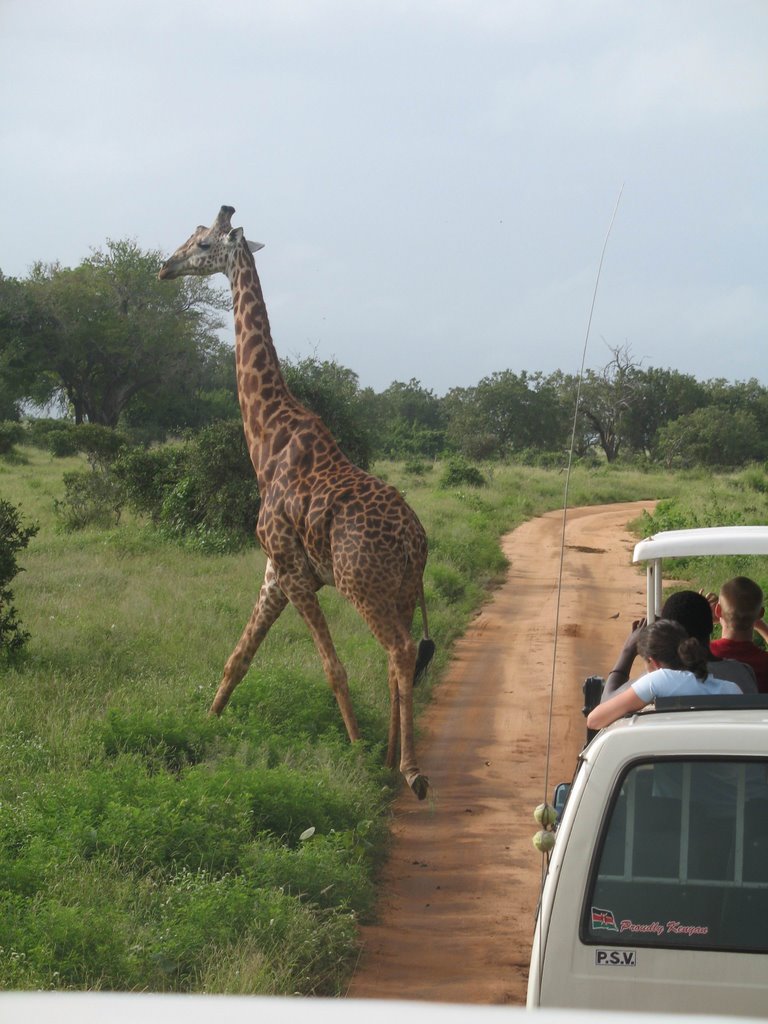
Tsavo National Park is about five hours east of Nairobi... it is a place with dense underbrush and extreme landscapes... the perfect place for stories and legends. Beginning in March of 1898, when the railroad was being built from Kenya to Uganda, the lions of Tsavo are said to have devoured over 142 railway workers as they camped by the sight. The workers built fences, set traps and ambushes, but the maneless male lions were too sly to be caught and managed night after night to drag the workers from their tents. Finally, on December 9, 1898, engineer J.H. Patterson shot the first of the two lions and the second followed three weeks later. Their reign of terror was over.
Last week, all of the volunteers travelled to this fabled park for a weekend retreat. Unfortunately, we saw none of the famous man-eating lions, but we did see elephants, zebras, water buffalo, and a few giraffes who held up traffic as they crossed the road! It was a wonderful way to end our time here in Nairobi as Kari and I prepare to head back to Icaciri later this afternoon, and it gave all of us a chance to come together and rest from our normal routines. It was also a great reminder of the amazing history and wildlife that this country has to offer... what a wonderful experience!
Saturday, December 30, 2006
December Newsletter
It has been a busy and eventful month for me. My school closed for the December holiday on November 23, so Kari and I moved to Nairobi to live and work. This city is quite a change from Gatundu, and I have learned about an entirely different aspect of life in Kenya. When we first got here, we weren't sure what sort of things we would be doing, but soon discovered that we would be moving from rural life straight into the center of an urban slum, Korogocho, to be specific. Every morning we travelled from our home in Westlands through downtown Nairobi to the nearest matatu stage and then walked the remainder of the way to Tumaini Church through the roads and alleyways of Korogocho. I must admit that the first day I was absolutely terrified. The only instructions we were initially given was to "carry nothing, wear no jewelry, and dress in very casual clothes." What were we getting into?
As it turns out, we had the opportunity to participate in a camp run by the TULIP ministry that encourages both discipleship and scholarship in the girls that it sponsors. This organization takes girls from the slums, girls who have few options in life, and teaches them first about Christ and then pays for their education. The girls themselves are amazing. They are open and honest about their lives, they are not ashamed or embarrassed by the circumstances of their birth. My very first day at camp, two girls from my Bible study group walked me around the area and asked quite frankly "Have you ever been in a slum before?" I had no idea how to respond.
After camp ended, Kari and I began tutoring a smaller group of girls. We discussed chemistry, biology, history, English, business studies, Christian education, basically everything they study in school except Kiswahili, which became a running joke between us as they taught us new phrases each day. As we made our way to the church which we turned into a schoolhouse each morning, we got to know not only the girls, but also the residents of the pathways we walked. We became accustomed to the sight of many things: the man selling bottles of a sticky red "cure-all" medicine where the paved road ended and the dirt began, the boys with carts of boiled eggs and sausages at the matatu stage, the women sitting on potato sacks under umbrellas peddling half rotten bananas and avocados, the old and the young sifting through piles of garbage that lined the roads. Most of all we got to know the children who inhabit Korogocho, or at least the small corner that we know, and each morning I looked forward to them running full force in our direction screaming "Wambui! Wangari! How are you?" We picked them each up individually, swung them around in the air, and set each one down laughing, only to repeat the process again. I left on our last day, my white t-shirt covered with smudged, dirty fingerprints from dozens of tiny hands that hugged me on the way out.
I am not sure what to think of the time that we spent in Korogocho. I am thankful for the opportunity to see another way of life, to know the faces and the stories, yet it brings me back to the same questions that I cannot answer. On our last day, one of the girls took us to her home for tea. Leon is one of five children supported solely by her mother who sells vegetables at a makeshift stand down the road. Their home is made of sticks and mud with a dirt floor and a tarp ceiling to keep out rain. The outside is lined with scraps of tin and the smell of sewage is ripe everywhere you turn. How do I react? Do I feel sadness? Anger? Pride? I am angry at the circumstances that have forced them into this life, sad at the brokenness of our world, yet proud of who they are and happy for what they have.
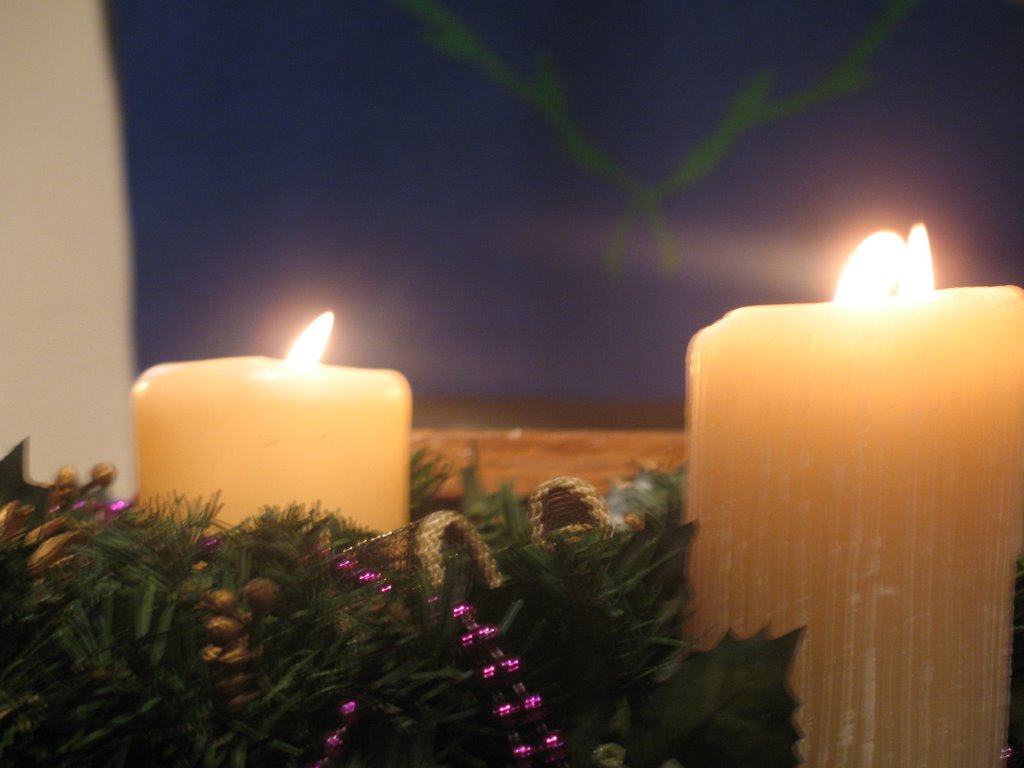
This month we celebrate the coming of our Lord into the world, the birth of Jesus Christ. Throughout Advent I have sung the familiar carol "O Come, O Come Emmanuel" each week. As I sat in candlelight at the Christmas eve service, I began to think about what it means that Christ would come into a world of such brokenness and dwell among us. I wondered at the circumstances of his birth and life. Then I realized, of course Christ was born in a manger to poor, marginalized parents, that is how most of the world lives today. Of course the smell of dirt and manure permeated the air, that is the smell most of the world knows. Emmanuel, God with us, God with all of us. The same God, with us in Korogocho and Darlington. The same Christ offers us respite from the reality of our own sin and brokenness. And He is not only with us, He is also in us. Christ is the hope, the light, and the beauty in each of us. He is the love and joy of God given to all of mankind.
Rejoice, rejoice! Emmanuel, shall come to thee, O Israel!
Thursday, December 28, 2006
Merry Christmas
 Holidays this year have been decidedly different than any other time in my life... on Thanksgiving I ate Chinese food with three of the other volunteers and on Christmas eve, I had Ethiopian for lunch with some friends in Nairobi... neither what my mom would usually allow! Also, December is one of the hottest months in Kenya, so instead of getting colder, the temperature has been steadily rising... definitely a change from Lexington, VA.
However unusual it may have been, Christmas eve was one of the most delightful days I have spent here. I started off the morning listening to Pastor Bob preach a sermon about how God's grace arrives in our world through Jesus Christ, and as we stood to take communion, I could feel the in pouring of God's love and peace into my life. I could sense the joy that we have only in Him, and it provided a welcome rest from all of the questions and frustrations that have plagued me recently.
After worship, we travelled to Askah's house (one of the members of the NILC congregation) to sing Christmas carols and pray over her as she recovers from surgery. It was such a blessing to be a part of the community here, to see the faith that Askah and her family demonstrated in the face of enormous difficulty.
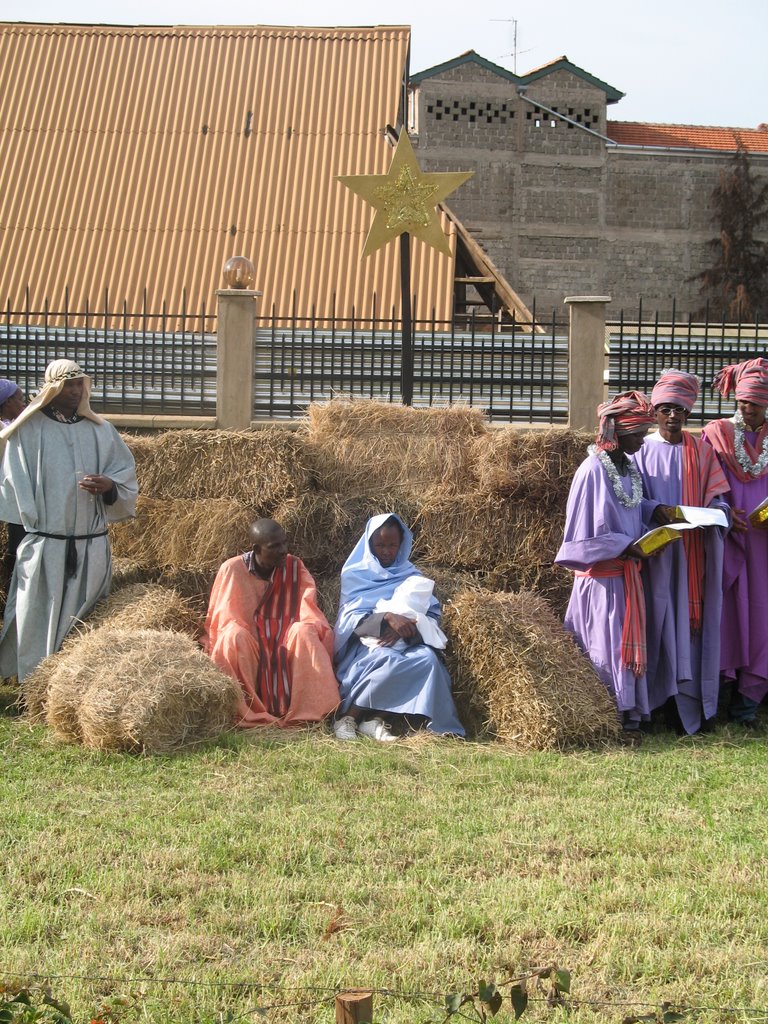
Next, we joined Pastor Bob and his family for Ethiopian food, and then it was back to church to participate in a live Nativity scene... there were wisemen, shepherds, cows, goats, Mary, Joseph, and an entire host of angels raising their voices in songs to celebrate the birth of Christ... it was beautiful, and the look on the faces of those passing by was priceless. As afternoon faded to evening, we all made our way into the sanctuary for the Christmas eve service, for a time when God's love and acceptance were evident in the community all around me. This year, I have been more able to see Christ as the original Christmas gift... without the promise of Santa Claus, I could look forward to the revelation of God's magnificent love through Jesus. As the noise of the afternoon quieted, the words of a familiar carol struck me afresh:
Silent night, holy night!
Son of God, love's pure light
Radiant beams from your holy face,
with the dawn of redeeming grace,
Jesus, Lord at your birth.
Jesus, Lord at your birth.
As we sat in the candlelight, in anticipation of that miracle of all miracles when God became man, I thought of the impossible hope, the joy, the healing that are bound up in that child, and I prayed for Christ to be born again, to be born in me.
Tuesday, December 12, 2006
Children of Korogocho

As Kari and I go to work each day in Korogocho, we have developed quite a following among the local children. We have had the unexpected blessing of getting to know some of these small, small ones as we wait for the girls we are tutoring to arrive each day. We dance and play, and sing the "banana song" together each morning... their smiles and laughter are absolutely infectious, so I wanted to share a piece of it with all of you.
Jesus said "let the little children come to me," and He must have meant the screaming, mischievous masses of barefoot little ones who run through the streets here. Who yell out "kawaru! kawaru!" which means potato instead of "how are you?" and then scamper off giggling as Kari and I walk by. To look at their surroundings, I see pain and poverty, but to look in their faces, there is all of the joy and playfulness of childhood.
For more pictures:
http://www.kodakgallery.com/ShareLandingSignin.jsp?Uc=ao36oqbn.3nv7bn8b&Uy=jm2qtn&Upost_signin=Slideshow.jsp%3Fmode%3Dfromshare&Ux=0&UV=154977108073_212627238107
Thursday, December 07, 2006
Out of My League
As I have mentioned before, Kenyan schools operate on a different time schedule than their American counterparts... 1st term lasts from January until the end of March, 2nd term lasts from May until the end of July, and 3rd term lasts from September until the end of November. With that being said, my school recently closed for holiday, and I am now in Nairobi. When Kari and I left Icaciri, we had no idea where we would be volunteering this month or what we would be doing. After a few days of uncertainty and a few meetings with our coordinator, Phyllis, we got a phone call instructing us to meet at St.Andrews PCEA church at 8:00 last Wednesday morning. Little did we know what was in store for us.
We met Rosemary at the specified time and proceeded to follow her through the crowded streets of Nairobi to a matatu stage downtown. As it turns out, we spent most of last week working with the TULIP ministry at a camp for girls in Korogocho, one of the city slums. Never in my life have I been anywhere like a Kenyan slum. As we walked through narrow alleyways with rusty homes made from whatever scraps of tin could be found, trying to avoid the streams of sewage and refuse that ran through the garbage paved paths, I wondered what the girls we were on the way to meet would be like. Would they be bitter? Would they be angry? Each day last week, we spent time in Bible study, listening to speakers, and practicing vocational skills along with about 60 teenage girls. We sang with these girls, we ate with them, we laughed with them, we strung together beads for bracelets and necklaces. Girls who have grown up in the slums, who have dealt with all of the difficulties that life at the bottom of the third world means. Girls who have watched their parents and friends suffer and die of AIDS, girls who know what it means to be abandoned, to be hungry, to look at life and see only darkness. And yet they themselves are the light. They are the hope and beauty of tomorrow. Through the TULIP ministry, the girls that qualify are sponsored in secondary school and therefore have a chance to get an education and to end the cycle of poverty that traps so many women and children.
There were and are definitely moments when I look around at our surroundings and think I have no idea what I am doing ... I have absolutely no experience to prepare me for this... I am way out of my league here. Yet God has been with me each moment, and He has shown me how real faith can be. As I sat with Group 9 in Bible study each morning, I was amazed at the strength demonstrated by each girl. I found myself asking "what difference does God make here?" and they continually reiterated the fact that God makes all of the difference.
We met Rosemary at the specified time and proceeded to follow her through the crowded streets of Nairobi to a matatu stage downtown. As it turns out, we spent most of last week working with the TULIP ministry at a camp for girls in Korogocho, one of the city slums. Never in my life have I been anywhere like a Kenyan slum. As we walked through narrow alleyways with rusty homes made from whatever scraps of tin could be found, trying to avoid the streams of sewage and refuse that ran through the garbage paved paths, I wondered what the girls we were on the way to meet would be like. Would they be bitter? Would they be angry? Each day last week, we spent time in Bible study, listening to speakers, and practicing vocational skills along with about 60 teenage girls. We sang with these girls, we ate with them, we laughed with them, we strung together beads for bracelets and necklaces. Girls who have grown up in the slums, who have dealt with all of the difficulties that life at the bottom of the third world means. Girls who have watched their parents and friends suffer and die of AIDS, girls who know what it means to be abandoned, to be hungry, to look at life and see only darkness. And yet they themselves are the light. They are the hope and beauty of tomorrow. Through the TULIP ministry, the girls that qualify are sponsored in secondary school and therefore have a chance to get an education and to end the cycle of poverty that traps so many women and children.
There were and are definitely moments when I look around at our surroundings and think I have no idea what I am doing ... I have absolutely no experience to prepare me for this... I am way out of my league here. Yet God has been with me each moment, and He has shown me how real faith can be. As I sat with Group 9 in Bible study each morning, I was amazed at the strength demonstrated by each girl. I found myself asking "what difference does God make here?" and they continually reiterated the fact that God makes all of the difference.
Monday, December 04, 2006
Photo Album
You can view pictures from my past few months in Kenya at the link below:
http://www.kodakgallery.com/ShareLandingSignin.jsp?Uc=ao36oqbn.9b4wiwnn&Uy=-mttlcs&Upost_signin=Slideshow.jsp%3Fmode%3Dfromshare&Ux=0&UV=199855143117_320490397107
http://www.kodakgallery.com/ShareLandingSignin.jsp?Uc=ao36oqbn.9b4wiwnn&Uy=-mttlcs&Upost_signin=Slideshow.jsp%3Fmode%3Dfromshare&Ux=0&UV=199855143117_320490397107
Tuesday, November 28, 2006
November Newsletter
 Give thanks with a grateful heart,
Give thanks to the Holy One,
Give thanks,
Because he’s given Jesus Christ his son.
And now, let the weak say “I am strong,”
Let the poor say “I am rich,”
Because of what the Lord has done for us.
Give thanks.
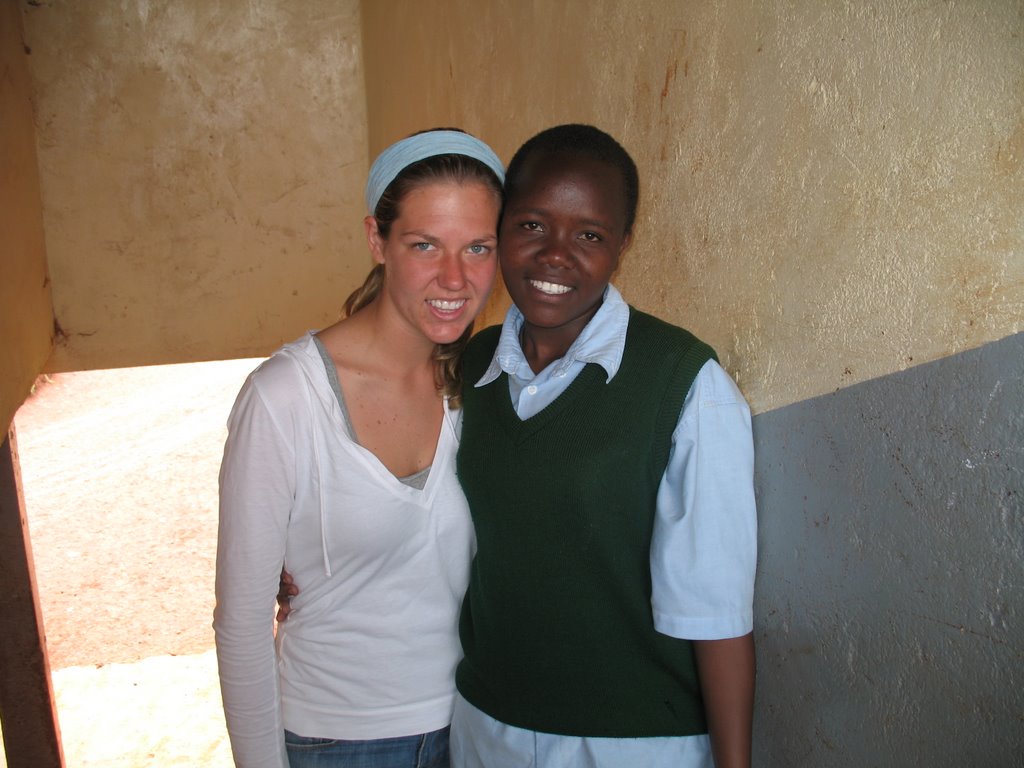
My life in the past few weeks has been comprised of very ordinary occurrences. I have been teaching biology each day to my Form 1 (freshmen) students and teaching Christian Education to two of the older classes. I wrote an examination and then graded somewhere over 200 examinations in return. I walk to town and buy produce in the local market where the colors and smells are as tangible as the tomatoes, onions, and pineapples themselves. I actually spend a large amount of time washing my clothes, and I am quite convinced that God is paying me back for every single time I packed up a month's worth of dirty laundry in Lexington, VA and drove it down home to Darlington for my mom to wash. Now I would be quite happy to put my own clothes in the washing machine, but instead, I put my clothes in my grayish-silver bucket, boil some water, scrub each piece individually, rinse them thoroughly, and then hang them out to dry, which takes a bit longer during the rainy season. Life is becoming more settled and routine. I am learning what it really means to live here. As I walk down the road now, children stop and greet me with a smile instead of running away screaming or laughing hysterically. I spend time with our students, singing, dancing, talking, worshipping. They have a million questions for Kari and I about life outside of Kenya, and I have just as many for them about their lives and culture. When we leave school now for meetings in the city, our students hang out of the windows shouting about how much they will miss us.
Every Sunday Kari and I attend two worship services at Icaciri. First, we participate in a student lead service at 7:30 that I can hardly describe. Each morning we walk in to dancing, twirling, girls shouting praises at the top of their lungs. It is magnificent. Afterwards, we stick around for the community service which is completely in Kikuyu. As I sit through this service each week, I realize that even though I can't understand most of the words, there is something familiar and comforting about the commnity of faith, something that makes Icaciri PCEA Church feel like home thousands of miles from my actual home. There is something reassuring about the words of the Lord's Prayer being recited in unison, even if they are not my words. Living here has helped me to realize the connection that each of us shares with the rest of humanity. Every time I walk down the street in Nairobi or look at the faces of my students, I am thankful for the beauty and diversity that exists in our world. I realize over and over again how great our God must be that He made each of us as individuals. What speaks to my soul may be different from what speaks to yours. Yet we are all made in God's image, and that image is reflected differently in each of us. The image of God is made manifest in hundreds of races and ethnicities, in thousands of languages, in millions of faces throughout the world. In Kikuyu the word for God is Ngai, in Swahili it is Bwana, the Jews called Him Yahweh, we call Him Lord. And He answers to every single one, and He delights in each of us when we call out to Him.
Swahili phrase: Asante sana. Thank you very much.
Saturday, November 18, 2006
Unexpected Blessings
Take off your sandals, for the place you are standing is holy ground."
Exodus 3:5
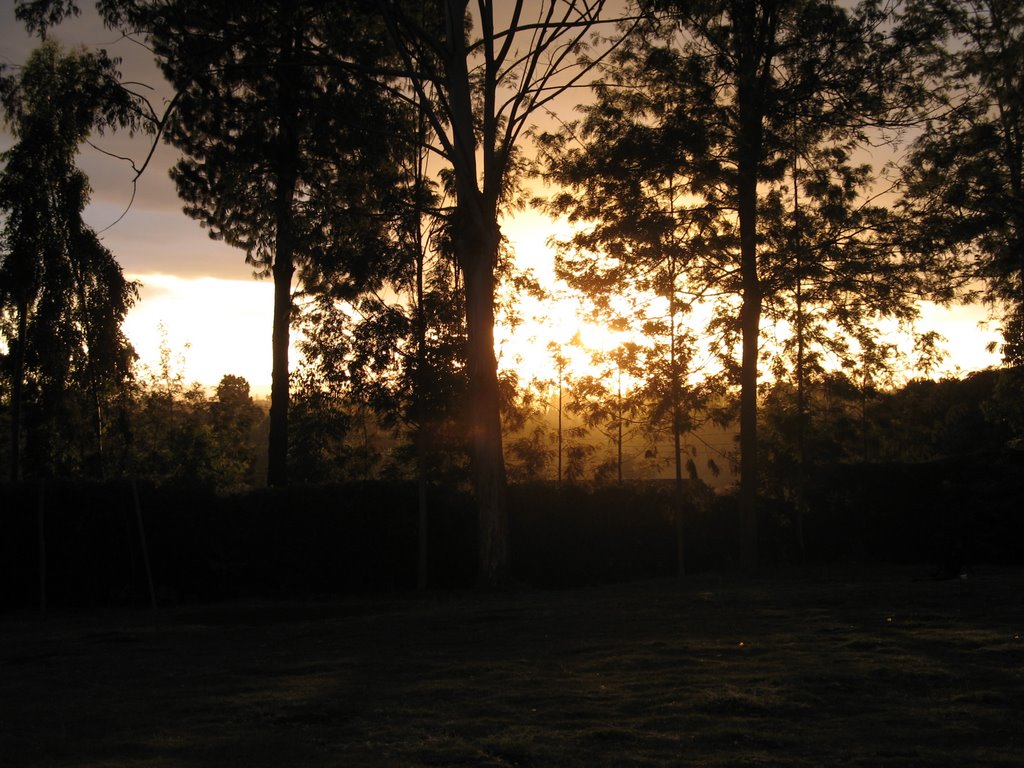
There was a moment a few weeks ago when I looked around at my students and could only think about how different we are. I could only see that they had grown up in rural Kenya, that most have never had electricity or dependable water, that their families and traditions look nothing like mine. I was mad at the rain that drenched me only hours before, and as I sat looking at a family struggling not to lose all that they had, the absence of God was more evident to me than His presence.
Yet as we rode home on the bus at the end of the afternoon, the air was filled with the joyful noise of our students singing praises to mighty God. Their energy and laughter brightened my soul as I could feel the gracious voice of my Lord whispering: I am still here. I am still with you, in the midst of darkness and doubt, I will not abandon you. Despite times of frustration and doubt here, always one crucial fact remains:despite the disparity between rich and poor, sick and healthy, American and Kenyan, black and white, Christian and Muslim , young and old, beneath all of our labels and differences, we share one basic thing, and that is life. We all have, for this brief moment, each of us, a part in the beauty and the pain, the ordinariness and the sanctity of this mystery that we call living. We are all bound to one another simply by our being. And perhaps in these ordinary moments, in a market or on a school bus, these times when we share ourselves with one another, these are the moments that are sacred, these are the times when we are sitting or standing or riding on holy ground. I expected the afternoon to be tedious and ordinary, yet how glorious is our God that He turns what we expect to be ordinary into unexplainable blessing. The songs of my students were their gift to God, which He in turn shared with me.
Friday, November 17, 2006
Harambee
Harambee is an ideal left over from the Kenyan struggle for independence which means a "coming together" or "uniting." It is a beautiful sentiment and leads to beautiful events where entire communities come together to support one another in times of need or crisis. My first experience with a harambee came last Saturday as all of the teachers and staff from Icaciri were invited to participate in the support of a family in our community. One of the Form 1 or freshmen students, Margaret, passed away from heart failure the same week that I arrived in Gatundu, so one of my first experiences here was her burial. Unfortunately medical care is scarce in rural areas and expensive when it is available, so her week long hospital stay cost her family everything that they had in terms of money, and they were forced to offer the title deed to their land as payment. Here in Central Province, land means much more than just the place where a family lives, it is their livelihood and a guarantee that they will have food and provisions for the future. For a family already struggling to survive, to lose your land is an unthinkable detriment. So, on Saturday, people from our commnity came together at a local PCEA churh to share music, food and laughter and to offer money and prayers in support of this family. The people of our community offer whatever they have, whether it is much or it is little, in the hope that the family who already lost their first-born daughter will not lose their land as well.
One would think harambees would be somber, penitent events of mourning or sorrow, but indeed they are not. Saturday was an afternoon filled with joy, singing, and most of all hope. Hope in the power of people united for a common purpose, hope in the promise that when someone falls, a neighbor will be there to pick them up. Hope that has illustrated for me more powerfully than anything else what the body of Christ should look like.
One would think harambees would be somber, penitent events of mourning or sorrow, but indeed they are not. Saturday was an afternoon filled with joy, singing, and most of all hope. Hope in the power of people united for a common purpose, hope in the promise that when someone falls, a neighbor will be there to pick them up. Hope that has illustrated for me more powerfully than anything else what the body of Christ should look like.
Saturday, November 04, 2006
Happy Birthday Wambui
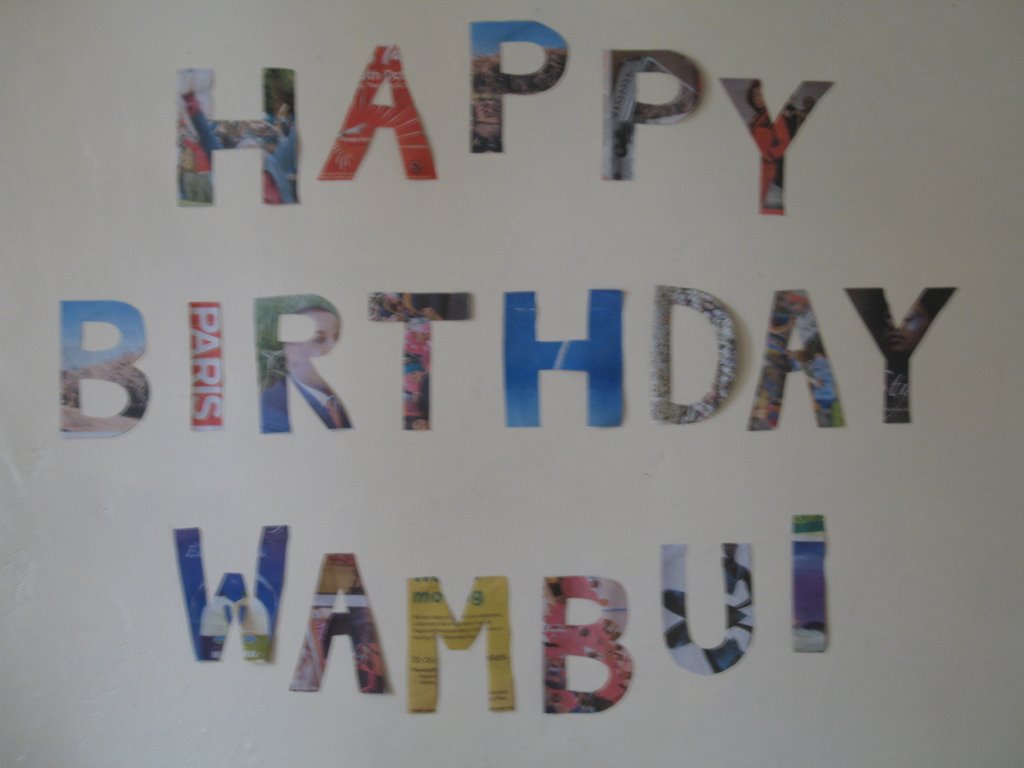
Many of you are probably wondering who Wambui is. Well, in the Kikuyu alphabet, there is no "L" and the "R" is pronounced differently than ours, which makes Lauren one of the hardest names imagineable. Therefore, after about two weeks of butchering my name in every conceivable manner, my colleagues christened me Wambui, a simple, easy to pronounce Kikuyu name. I now answer to either.
I woke up on the morning of October 29 at about 6:30 am to the sun shining through my mosquito net and the sound of African drums marching across the field as our girls prepared for Sunday worship. It was a beautiful day, and as I made my way out of bed and into the kitchen, I realized that my wonderful roommate had decorated our entire home with streamers, blown up latex gloves, and newspaper letters with a special birthday message. It was incredible!
After our breakfast of tea and mandazi, we made our way to the student worship service where we sang and danced and laughed much like we do every Sunday. We also stuck around for the Kikuyu service that the older members of the village attend, and we both ended up with children on our laps playing a "moja... mbili... tatu" version of pattycake that Kari invented last week. Naomi is a little girl of about 3 years who absolutely brightens my day with her smile every single time I see her, so it was a beautiful blessing to sit with her through the service that I cannot understand. It was such a joy to spend so much of my birthday praising the Lord who created me and who loves me more than any other.
After worship we returned home, I got to open some presents, we fixed lunch, and spent much of the afternoon doing laundry and getting dancing lessons from some of our students. I cannot think of a better way to celebrate the life God has given me than by spending it with those He has called me to serve.
Thanks to all of you who also made my birthday special with your cards, letters, and e-mails, I am continually humbled by the love and support I feel from all of you. God bless.
Subscribe to:
Posts (Atom)
